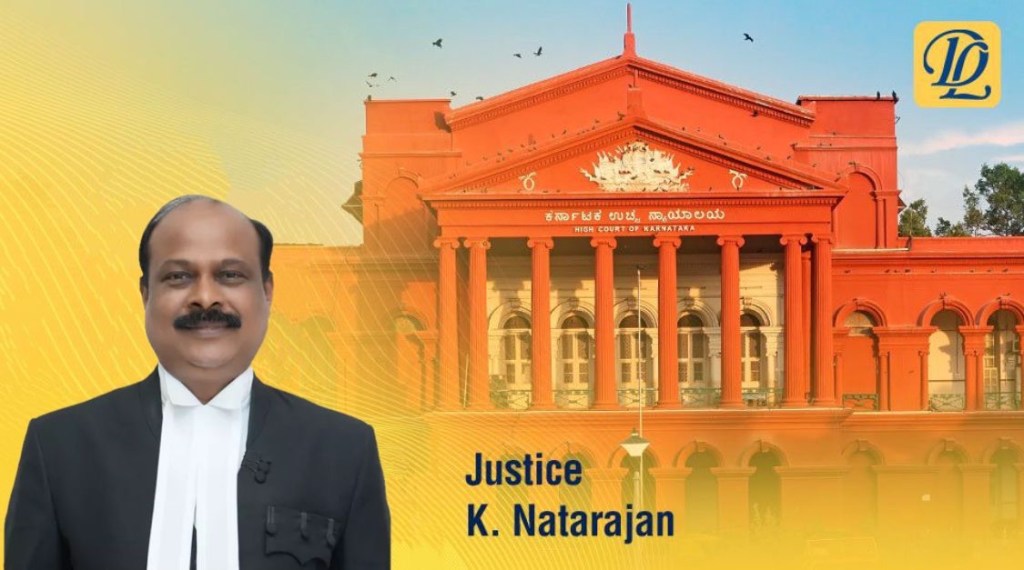
Hon’ble Mr. Justice K. Natarajan celebrates his 60th birthday today.
Hon’ble Mr. Justice Krishnan Natarajan:
Born on 05.11.1964 at Bengaluru City. Studied in Primary Education at Government Primary School, Shamanna Bungalow, Sultanpet, Bengaluru and Higher Primary Education at Government Boys’ Middle School, Mamulpet, Bengaluru; Secondary Education at Central High School, K.G. Road, Bengaluru; Pre-University Education at P.U. College, Magadi Road, Bengaluru; B.Com. Degree at Acharya PatashalaEvening College, Bengaluru; and, LL.B. Degree at V.V. Puram Law College, K.R. Road, Bengaluru.
Enrolled as an Advocate on 14.02.1992; Started practice under the guidance of Sri V. Jagadish Gowda, learned Advocate, Gandhinagar, in Magistrate Courts and Sessions Courts, Bengaluru.
Started independent practice from January 1995, both in the field of civil and criminal sides, at Bengaluru and other districts of the State of Karnataka. Appointed as a panel Advocate for New India Assurance Company, Bengaluru.
Selected as the District and Sessions Judge and took charge as the District and Sessions Judge on 27.05.2002. Worked as IV Additional Sessions Judge, Kalaburagi from 01.07.2002 till 2005; As an Additional City Civil and Sessions Judge, Bengaluru from 2005 to 2008; As Presiding Officer of Labour Court, Chikkamagaluru between 2008 and 2009; As Principal District and Sessions Judge at Bellary and Dharwad Districts between 2009 and 2013; As Registrar (Review and Statistics) and Registrar (Recruitment) at High Court of Karnataka, Bengaluru from 2013 to 2015; As Principal Secretary to Government of Karnataka, Law Department, Bengaluru between 2015 and 2016; As Principal Judge, Family Court, Bengaluru from 2016 to 2018; As Principal District and Sessions Judge, Shivamogga District from 31.05.2018 till elevation as the Judge of the High Court of Karnataka.
Appointed as an Additional Judge of the High Court of Karnataka on 03.11.2018 and as Permanent Judge on 26.02.2020.
Important Judgments delivered by Hon’ble Mr. Justice K Natarajan.
Advocate making defamatory statement in pleadings without obtaining signature of his clients cannot plead exception to Section 499 IPC. Karnataka High Court.
Criminal proceeding against Notary Public in respect of their official work without prior permission of the Central Government or the State Government is impermissible and is liable to be quashed. Karnataka High Court.
Failure to disburse dividend under the Companies Act, 1956 is a continuing offence. Recurring limitation extends until the payment is made. Karnataka High Court.
Unlike Company, if an offence is committed by Partnership Firm, it is an offence committed by its partners. There is no need to make Partnership Firm an accused in criminal case. Karnataka High Court.
Taking cognizance by the criminal Court cannot be set aside on the ground of defective or illegal investigation, unless illegality in investigation can be shown to have brought about miscarriage of justice. Karnataka High Court.
Magistrate cannot condone delay in filing private complaint, under Section 473 Cr.P.C. without issuing notice to accused/respondent. Karnataka High Court.
“Bhang is a traditional drink and the same is neither a narcotic drug nor a psychotropic substance unless it is prepared out of the substance of Ganja’. – Karnataka High Court.
Land Acquisition Act. In respect of the awards passed after 2013 Act, appeal is maintainable only under Section 74 of the 2013 Act and not under Section 54 of the 1894 Act. Karnataka High Court.
Judiciary. ”Woodpeckers inside pose a larger threat than the storm outside”. Karnataka High Court.
Appointment of eminent Senior Advocate under the SC/ST (Prevention of Atrocities) Rules, 1995 is a special measure to safeguard the interest of the victims. The same cannot be questioned on technical grounds. Karnataka High Court.
Matka gambling. Owner of the premises is also liable under the Karnataka Police Act though he was not present when the Police conducted the raid. Karnataka High Court.
Physically preventing public servant from discharging duties cannot be construed as part of fundamental right to assemble under Article 19(1)(b) of the Constitution. Karnataka High Court.
To determine weight of ganja to bring it under small or medium or commercial quantity, seeds and leaves cannot be excluded. Karnataka High Court.
When a partner commits criminal breach of trust in his individual capacity, the partnership firm need not be made party in the criminal proceedings. Karnataka High Court.
Conviction under Section 138 of Negotiable Instruments Act, 1881 cannot be questioned under Section 482 Cr.P.Cwhen appeal remedy is available. Karnataka High Court.
Negotiable Instruments Act. Section 138. Once NBW is issued against accused, the complainant need NOT take any further steps till NBW is executed or returned. Complaint can NOT be dismissed for not taking steps. Karnataka High Court.
Criminal trial. In appropriate cases, the Court shall suo moto summon the document which is in possession of any of the parties under Section 91 of Cr.P.C. Karnataka High Court.
Proceedings under PMLA initiated and seized properties forwarded to the Adjudicating Authority situated outside the State. Karnataka High Court rejects the challenge for want of territorial jurisdiction.
POCSO Act. Though victim shall not be called frequently for cross examination, fair trial being a fundamental right, the court shall not deny sufficient opportunity to the accused. Karnataka High Court.
Matka and OC gambling fall under Section 78(3) of the Karnataka Police Act which are non cognizable offences. Without seeking permission of the Magistrate under Section 155(2) of Cr.P.C, the police have no authority to register FIR and file the charge.
Negotiable Instruments Act. When accused is convicted and in appeal deposits 20% of the cheque amount as per the Court direction, the complainant is entitled for release of the amount in his favour. Karnataka High Court.
Section 125 Cr.P.C. Step mother can claim maintenance from the income of the property of her husband when she is incapable of supporting herself. Karnataka High Court.
Investigation agencies must communicate final report prepared by them to the first informant as per Section 173(2)(ii) of Cr.P.C. Karnataka High Court directs DG and IGP of the State to issue necessary instructions.
Registering FIR for non-cognizable offences without taking permission from the Magistrate and filing charge sheet without obtaining sanction is not sustainable under the law. Karnataka High Court.
Police adding cognizable offence along with non-cognizable offence in FIR and later dropping cognizable offence from the chargesheet. The same will not cure mandatory requirement of Sanction under 155 (2) of Cr.P.C. Karnataka High Court.
Though CCB is not a Police Station, CCB Police Officers appointed or identified as Investigating Officers can file the final report / charge sheet under Section 173 (2) of Cr.P.C. Karnataka High Court.
Prevention of Corruption Act. Court cannot act as chartered accountant or hold mini-trial while considering the challenge to the prosecution under Section 13(1)(e). Karnataka High Court.
Sub-Registrar cannot be prosecuted for registration of a bogus document. Karnataka High Court.
Suit for possession based on illegal dispossession shall be filed within six months from the date of dispossession. Subsequent amendment for possession in a pending suit for injunction will not cure the defect. Karnataka High Court.
Rejection of plaint under Order 7 Rule 11 cannot be resorted to at belated stage when the issues are framed and the suit is already posted for evidence. Karnataka High Court.
When agreement was entered in Gujarat and the work was executed in Kerala, Police/Magistrate at Bangalore do not have jurisdiction over the dispute simply because the complainant’s office is situated at Bangalore. Karnataka High Court.
Adverse Possession as Sword. Plea of adverse possession can be raised by the plaintiff by filing a suit for declaration to perfect his title. Karnataka High Court.
Negotiable Instruments Act. Maximum 20% that can be ordered by the Magistrate to deposit as interim compensation under Section 143-A may be also below 20%. Karnataka High Court.
Land granted by way of public auction on upset price to SC/ST persons cannot be considered as “granted land’’ within meaning of Karnataka SC/ST (PTCL) Act. Karnataka High Court.
Wife cannot initiate prosecution against husband’s girlfriend for allegedly abetting the husband to commit offence under Section 498A, IPC. Karnataka High Court.
’Entire complaint reads like autobiography with no offence made out’. Karnataka High Court quashes criminal proceedings initiated by wife against her in-laws and husband’s relatives u/s 498A, IPC.
Negotiable Instruments Act. When cause of action is same resulting in issuance of common notice, single complaint is maintainable for multiple cheques issued by the respondent/accused. Karnataka High Court.
Karnataka SC/ST (PTCL) Act. When violation of the Act is alleged and resumption is sought by way of an application, it is the duty of the Assistant Commissioner to consider the application. Karnataka High Court.
Suit for partial partition of joint family properties is not maintainable. Karnataka High Court.
Matka/gambling. Police officer shall obtain search warrant/permission before going to search and seize. Obtaining subsequent permission does not cure the illegality. Karnataka High Court.
A person out of possession cannot seek the relief of injunction simpliciter without claiming the relief of possession though his title to the property is not disputed. Karnataka High Court.
Specific Relief Act. Section 41(h). Agreement holder cannot file a suit for bare injunction without suing for specific performance. Karnataka High Court.
Mere failure to sell the property as per the agreement of sale or refusal to return advance money does not constitute criminal offence. Karnataka High Court.
Plaint cannot be rejected on the ground of limitation which is pure question of law and facts. Karnataka High Court.
When accident is caused by tractor, insurance company is liable to pay compensation even though the trailer is not separately insured. Karnataka High Court.
NDPS Act. Special Court/Magistrate has power to release the vehicle in question for interim custody under Sections 451 and 457 of Cr.P.C. Karnataka High Court.
 Daksha Legal