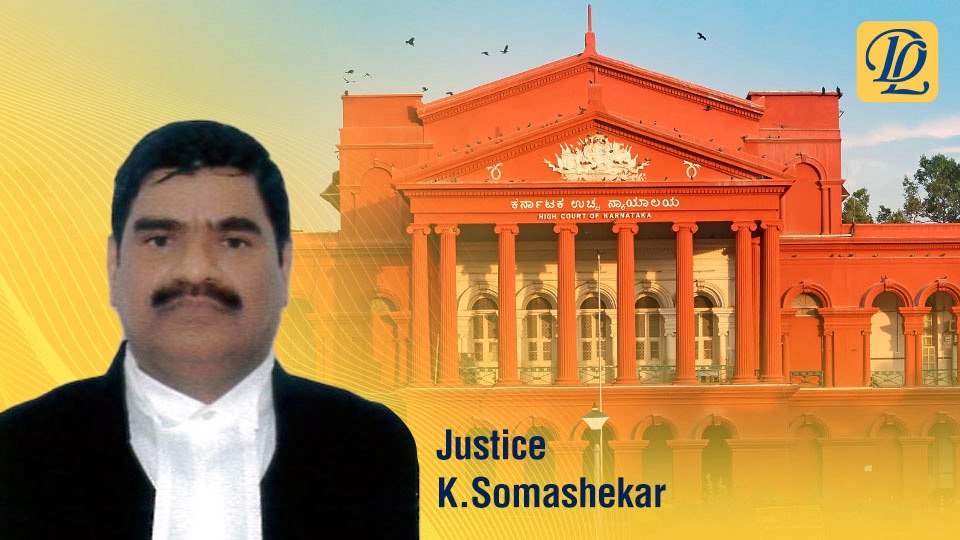
Hon’ble Mr .Justice K. Somashekar celebrates his 61st birthday today.
Hon’ble Mr. Justice K. Somashekar: Born on 15.09.1963. Enrolled as an advocate on 27.01.1990 and practiced in Mysore and Chamarajanagar Districts on both Civil and Criminal sides. Directly appointed as District and Sessions Judge on 17.06.1998 and served as Additional Districts and Sessions Judge at Bijapur(Vijayapura); and City Civil Court, Bangalore and Principal District and Sessions Judge at Uttara Kannada, Karwar District; Hassan; Bangalore Rural District, Chitradurga and Principal City Civil and Sessions Judge, Bangalore and also served as Registrar Judicial and Registrar Vigilance, High Court of Karnataka. Appointed as an Additional Judge of the High Court of Karnataka on 14.11.2016 and Permanent Judge on 03.11.2018.
Important judgments delivered by Justice K. Somashekar.
Criminal Trial. Wife cannot be dragged into criminal case simply because she is signatory to cheques along with her husband who is involved in illegal business transactions. Such practice should be curtailed. Karnataka High Court.
Mere payment of premium amount before occurrence of accident will not cover liability if the insurance policy is issued with effect from the time after the accident. Karnataka High Court.
“Victim compensation is the social philosophy and legislative implication. Failure on the part of the prosecution to secure a conviction is not a ground to deny compensation”. Karnataka High Court orders compensation to minor girl orphaned due to crime.
Presentation of undated cheque after three years from the date of the transaction by adding the date. Proceeding under Section 138 NI Act will be clearly barred by limitation. Karnataka High Court.
Criminal trial. In a case resting on circumstantial evidence, motive plays a crucial role. Motive is a double-edged weapon, which will cut either side of the case. Karnataka High Court.
Criminal trial. Insistence of plurality of witnesses in proof of any fact will indirectly encourage subornation of witnesses. Karnataka High Court.
Mining irregularities. Karnataka High Court upholds discharge of the accused involved in alleged illegal mining.
“Case of the prosecution in entirety is found to be doubtful and is full of inconsistencies”. Karnataka High Court acquits the accused in RTI activist Lingaraju murder case.
An order of acquittal adds up to the presumption of innocence in favour of the accused and hence the Appellate Court has to be relatively slow in reversing the order. Karnataka High Court.
Dowry Prohibition Act 1961. Wife roping in entire family members of husband with ulterior motive of wreaking vengeance. Such proceedings are liable to be quashed. Karnataka High Court.
When the prosecution fails to prove its case, benefit of the acquittal can be extended by the appellate court even to the accused who has not preferred appeal challenging the order of conviction. Karnataka High Court.
Criminal Law. Though due to passage of time and memory loss, witnesses deviate from their Police Statements, but when such discrepancies make the foundation of the prosecution case shaky, the Court has to take strict note thereof. Karnataka High Court.
When proceedings are initiated under the Karnataka SC/ST (PTCL) Act, the authorities are bound to examine whether the grant comes within the purview of the Act. Karnataka High Court.
If deposition of the child witness inspires confidence in the mind of the Court and there is no improvement or tutoring, the Court may rely upon the same. Karnataka High Court.
In determining culpable homicide under Section 299 of IPC, mentality of the accused, nature of the act and its effect upon the victim have to be analysed. Karnataka High Court.
Employees’ Provident Funds and Miscellaneous Provisions Act. Competent authority has discretion to reduce the percentage of damages under Section 14B and the same is justiciable. Karnataka High Court.
When accused are acquitted for the offences under Sections 498A, 304B IPC and Sections 3 and 4 of the Dowry Prohibition Act, conviction for the murder cannot be sustained. Karnataka High Court.
Lack of intention on the part of the accused and commission of the act in the heat of passion upon sudden quarrel are the mitigating circumstances. Karnataka High Court reduces sentence from Section 302 IPC to Section 304.
Criminal Law. When trial Court misreads the evidence and arrives at a conclusion erroneously to convict the accused, the appellate Court must intervene to prevent miscarriage of justice. Karnataka High Court.
Criminal law. To impose the extreme punishment, all the three tests; Crime test, Criminal test and Rarest rare test must be satisfied. Karnataka High Court converts imprisonment till last breath of life to life imprisonment.
Criminal Law. Subsequent voluntary statement of the accused cannot be admissible in evidence and recovery to that effect amounts to “rediscovery of a fact already disclosed and capable of discovery.” Karnataka High Court.
Service Law. Court cannot sit on perceptivity of the State Government in posting a person to a particular post except considering the eligibility of the person to occupy the post. Karnataka High Court.
Failure to furnish legible and translated copies of the documents supporting the preventive detention to the detune vitiates the detention order. Karnataka High Court.
Income Tax Act. Proceedings regarding escaped assessment and notices under Section 153C solely based on loose sheets and documents which are termed as ‘diaries’ found during the search are unsustainable. Karnataka High Court.
It is not always mandatory for the State Government to script the reasons for transfer of public servant when the reasonings are reflected in the records for obtaining prior-approval from the Chief Minister. Karnataka High Court.
 Daksha Legal