
S. Basavaraj, Senior Advocate & Member, Karnataka State Bar Council.
Plagiarism, the act of presenting someone else’s ideas as one’s own, is universally criticized in academia, and the judiciary is no exception. A cornerstone of ethical judgment writing is the obligation to credit and cite the work of fellow judges when their precedents influence the course of legal reasoning.
At its core, plagiarism undermines the very essence of justice. Judges, as arbiters of truth and fairness, are entrusted with the task of shaping legal principles and setting precedents that guide future decisions. Yet, when a judge appropriates the ideas of another without due credit, the foundations of trust and integrity are compromised.
The Gujarat High Court recently in the case of Anjanaben Modha vs State of Gujarat recognized Marital Rape as a criminal offence. The Single Judge was hearing a bail application filed by the accused mother-in- law in a case involving the victim’s husband, father-in-law, and mother-in-law who were arrested for the offences of rape, gang rape, cruelty, criminal intimidation, sexual harassment and other offences under the Penal Code.
The judgement has made major headlines, especially for considering the fact that the issue of criminalization of marital rape has been a highly debated topic. There are in fact only a handful of judges in our country who have taken the bold stand and have criminalized marital rape. One such judge who deserves a worthy mention is Justice M. Nagaprasanna of Karnataka High Court who infact was amongst the very first judges in the country to have criminalized Marital Rape. Justice Nagaprasanna had provided a very detailed analysis on the issue of marital rape in the case of Hrishikesh Sahoo vs State of Karnataka last year.
While the stand taken by the learned single judge of the Gujarat High Court is definitely commendable, one cannot ignore the glaring similarity between the two judgements. Judgments articulate the judge’s legal reasoning and analysis. They explain how the judge arrived at the decision by applying relevant legal principles to the facts of the case. This process often involves a thorough examination of statutes, precedents, and legal arguments presented by the parties.
This article is therefore an analysis of the Gujarat High Court’s judgement to show how the learned judge has borrowed huge excerpts from Justice Nagaprasanna’s judgement without referring to the judgment of the Karnataka High Court.
The judgement starts off by the use-age of the term ‘Factual Expose’, a term which though used in common parlance, was also how Justice Nagaprasanna starts off writing his judgement on Marital Rape too.

Left: Justice Nagaprasanna’s Judgement highlighted in green; Right: Gujrat High Court Judgement highlighted in red, Both taken from their respective High Court Websites.
Then the learned judge of the Gujrat High Court goes on to consider the arguments of both the parties leading to the framing of the issues for consideration, a format which is followed in most judgements. However, each judge frames such issues by themselves looking at the facts at hand. Framing of issues in a judgment is a critical aspect of judicial decision-making. It involves the identification and formulation of the key legal and factual questions that the court must address in order to reach a decision. The way in which issues are framed helps structure the analysis and guides the court in applying the law to the specific circumstances of the case.
What is suprising here is that learned judge of the Gujrat High Court has not only copied the issues that were framed in Justice Nagaprassana’s judgement but has also copied the very manner in which he considers the submissions of both the parities.
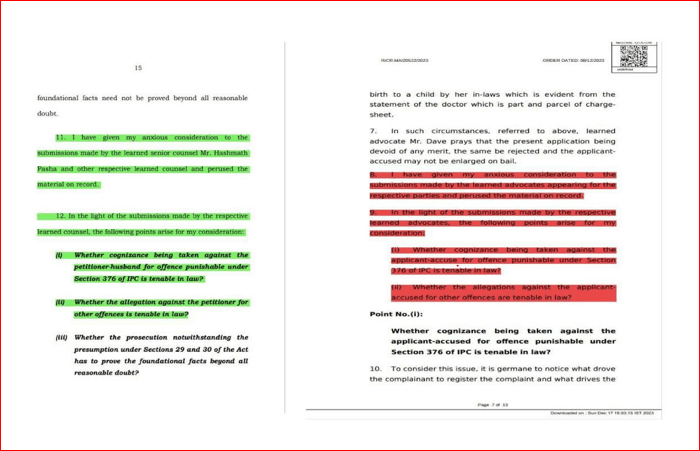
Side by side comparison of how learned judge of the Gujrat High Court (Right) has verbatim copied from Justice Nagaprasanna’s Judgement (Left)
While this can still be excused, what is unfortunate is that learned judge of the Gujrat High Court has gone on to even copy the analysis and opinion of Justice Nagaprasanna. In cases where judges draw inspiration from the work of others without appropriate citation, the potential for inadvertent plagiarism arises.
This not only compromises the integrity of the judgment but can also lead to a misrepresentation of the judge’s own contribution to legal scholarship. By conscientiously crediting the ideas and reasoning of fellow judges, the judiciary can uphold the principles of intellectual honesty and maintain the public’s trust in the legal system. Courts have for ages held that judges must apply their mind while writing their judgements because opinions and reasoning reflects the mind and thinking of a judge.
The learned judge of the Gujrat High Court seems to have taken such direction of the court a notch higher by even copying a fellow judges application of his mind. In this discussion it would be appropriate to notice how the learned judge of the Gujrat High Court has verbatim copied Justice Nagaprasanna’s writing style while discussing ‘Point (i)’.

’Point (i)’ in the Judgement of the learned judge of the Gujrat High Court (left) is exactly similat to ‘Point (i)’ in Justice Nagaprasanna’s Judgement (Right)
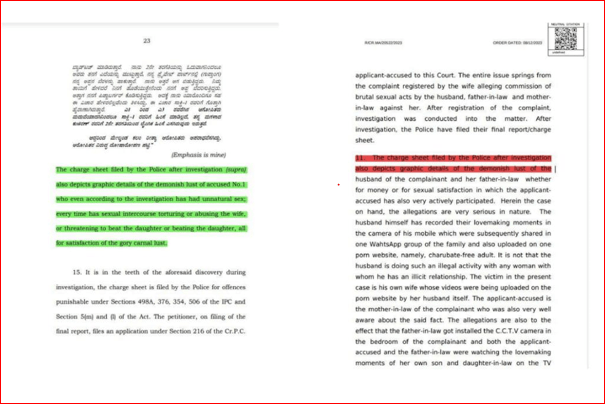
Another example of how the learned judge of the Gujrat High Court has copied Justice Nagaprasanna’s (left) writing style
It’s unfortunate how every para which was written after meticulous research and analysis by Justice Nagaprasanna was replicated without even a change in wording. Justice Nagapasanna’s reasoning and interpretation of Marital Rape has provided a valuable contribution to the jurisprudence of Marital Rape in India. One should therefore have atleast cited the judgement if they were to follow the same reasoning. Moreover, proper citation is a powerful tool for building a robust legal argument. When judges cite the work of their peers, it adds weight to their own analysis, reinforcing their conclusions with the authority of precedent.
Justice Nagaprasanna has not only discussed the concept and position of Marital Rape in India but has also gone on to consider how other countries like American, Australian States, New Zealand, Canada, Israel, France, Sweden, etc. have treated this issue too.
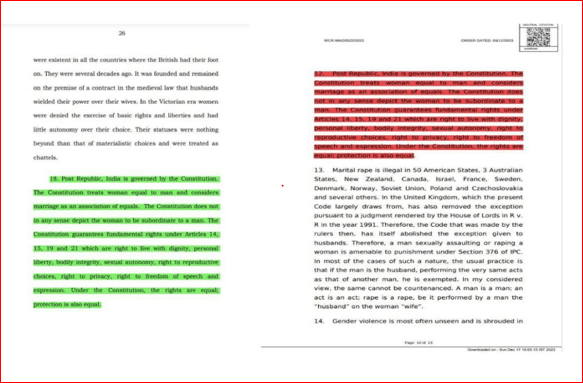
Justice Nagaprasanna’s (right) analysis of the position of a woman in India under the Constitution copied word to word by the learned judge of the Gujrat High Court (left)
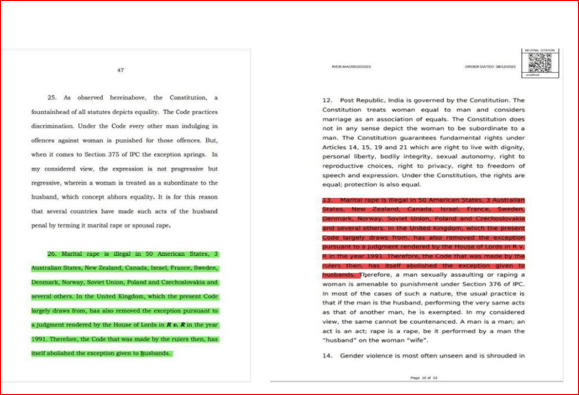
Justice Nagaprasanna’s (right) analysis of Marital Rape in foreign jurisdictions copied verbatim by the learned judge of the Gujrat High Court (left)
Due to this, many reputed news portals including Bar&Bench, LiveLaw, Hindustan Times, TOI etc. have given all credit of such well written reasoning and analysis to the learned judge of the Gujrat High Court!

Excerpts form the articles on Bar&Bench (left) & TOI (right) giving credit to Justice Gujrath High Court Judge for the work and reasoning of Justice Nagaprasanna

Excerpts from the articles published by Live Law giving credit to the learned judge of the Gujrat High Court for the work of Justice Nagaprasanna
Crediting other judges in judgment writing is not a mere formality; it is an acknowledgment of the collaborative nature of legal scholarship. The legal landscape is a tapestry woven by the collective wisdom of jurists who have preceded us. To ignore this interconnected web of legal thought is to diminish the richness of the law and deny the contributions of those who have shaped it.
Ethical judgment writing demands an appreciation for the distinction between inspiration and imitation. While judges may draw insights from the work of their peers, it is imperative to offer due credit. Failure to do so not only jeopardizes the credibility of the judgment but diminishes the intellectual integrity of the judge responsible.
What is infact astounding is that many legal news websites including Live Law while reporting Justice Nagaprasanna’s judgement on Marital Rape have discussed the same portions in the judgement of the learned judge of the Gujrat High Court too.

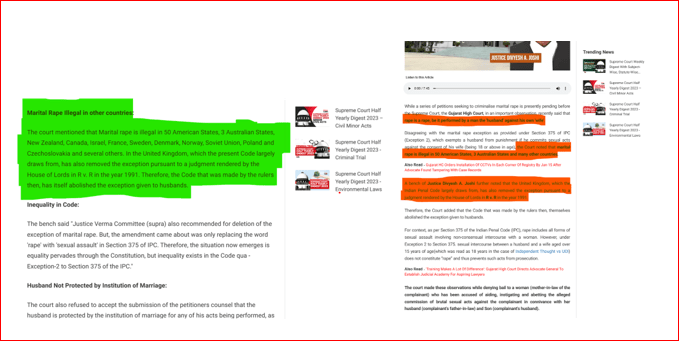
A side by side comparison of the articles published on Live Law for Justice Nagaprasanna’s (left) Judgement on Marital Rape and the judgement of the learned judge of the Gujrat High Court on Marital rape
As can be seen from above the learned judge of the Gujrat High Court has inexcusably been given credit for the very same analysis of Marital Rape by Justice Nagaprasanna.
The last point for consideration ‘Point (ii)’ too has been copied without change of even a single word. If this is not a case of outright plagiarism, then one doesn’t know what can be construed as a case of plagiarism.
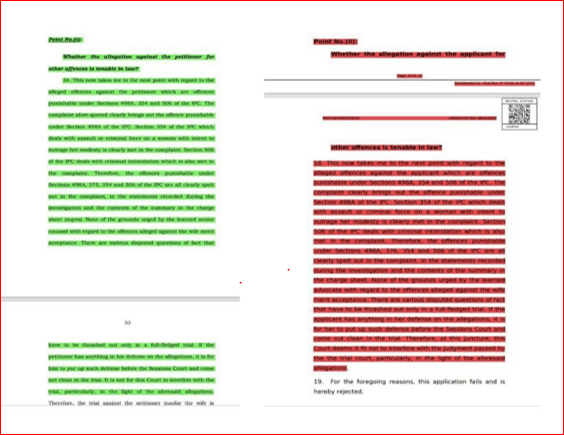
A comparison of the learned judge of the Gujrat High Court judgment and Justice Nagaprasanna’s (left) judgement showing absolute plagiarism
Infact even a report on a reputed plagiarism software, Turnitin showed a similarity index of around 48% out of which around 28% was copied from Justice Nagaprasanna’s judgement published on a website called latestlaws.com . Therefore, as can be seen the entire reasoning in the judgement of the learned judge of the Gujrat High Court has been copied from the judgement of Justice Nagaprasanna without giving him the due credit.
In fact this is not the first instance of plagiarism by sitting judges of our judiciary. A Single Judge Bench of the Delhi High Court had copied certain contents of an article in it’s judgement titled F.Hoffmann-La Roche Ltd vs. Cipla Ltd. The bench had however offered an apology to the learned authors of the article and simultaneously took corrective action of the same.
The ethical imperative of crediting other judges in judgment writing is non-negotiable. Plagiarism has no place in the sanctum of justice, where integrity and fairness must reign supreme. If there are allegations or suspicions of copyright infringement by a judge, it should be treated as a legal matter to be investigated and adjudicated like any other case.
By conscientiously acknowledging the influence of fellow jurists, judges not only demonstrate respect for intellectual property but also contribute to the enduring strength and credibility of the legal system. The principles of justice and ethics are inextricably linked, and it is through the ethical conduct of judges that the judiciary preserves its honor and the public’s trust in the pursuit of a just society.
Photo Courtesy – Porositweb
 Daksha Legal