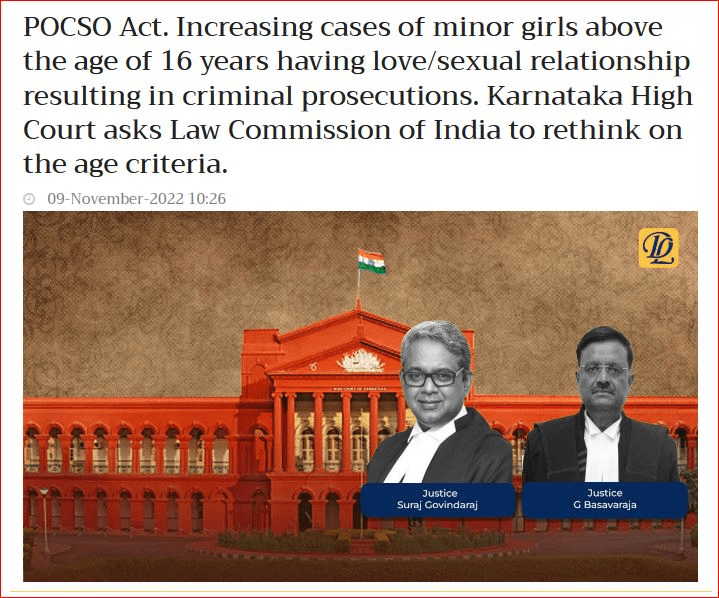
The 22nd Law Commission headed by Justice Justice Ritu Raj Awasthi has taken note of the Karnataka High Court judgment in State of Karnataka vs Basavaraj Yellappa Madar, Criminal Appeal 100515 of 2021 decided on 4 November 2022 (Justice Suraj Govindaraj and Justice G. Basavaraj) while recommending amendments to POCSO Act.
The Karnataka High Court while disposing the Criminal Appeal observed, inter alia, that “the aim and objective of POCSO Act is to protect the minor children from sexual exploitation and it is made clear that a minor cannot provide consent, the minor under POCSO Act being a person under the age of 18 years. Having come across several cases relating to minor girls above the age of 16 years having fallen in love and eloped and in the meantime, having had sexual intercourse with the boy, we are of the considered opinion that the Law Commission of India would have to rethink on the age criteria, so as to take into consideration the ground realities”
The Law Commission, while referring to Karnataka High Court Judgement recommends amendment to POCSO Act to address situations where there is approval, even if not explicit consent in the eyes of the law, from children aged between 16 and 18 years who are in intimate relationships. The Commission says that such cases should not be treated with the same severity as those that were originally envisioned to fall under the POCSO Act.
Therefore, the Commission has determined that it is appropriate to introduce guided judicial discretion in the sentencing of such cases to ensure a balanced approach that safeguards the best interests of minors.
The Karnataka High Court raised concerns about the increasing number of cases involving minor girls who are above the age of 16 years engaging in romantic relationships, eloping and having sexual intercourse with boys.
The Madhya Pradesh High Court also drew the Commission’s attention to the problems while enforcing the POCSO Act. The Karnataka High Court pointed out the injustice that occurs in cases of statutory rape where there is de facto consent from the girl. The Commission was requested to recommend amendments to the POCSO Act, granting discretionary power to special judges.
The Commission has recommended amendments to Section 4 and Section 8 of the POCSO Act, Sections 375 and 376 of the Indian Penal Code (IPC), as well as the inclusion of a proviso and an explanation in Section 18 of the Juvenile Justice Act.
The report has recommended that after sub-section (3), sub-sections (4) to (9) should be added. These additional sub-sections would grant discretion to the courts to reduce sentences in cases where there is approval, though not statutory consent, of a child above sixteen years of age.
The report also suggests renaming Section 8, which currently provides punishment for sexual assault, as Section 8(1). Additionally, sub-sections (2) to (7) should be incorporated to empower the courts with discretion to reduce sentences in similar cases.
The Commission recommends that courts take various factors such as the child’s tacit approval, the age difference between the accused and the child, the accused’s lack of criminal history, whether or not a child was born out of the offence and other circumstances like family acceptance or marriage into account.
The Commission suggests that offenders falling under the new sub-sections introduced in Section 4 and 8 of the POCSO Act should be included within the scope of Section 18 of the JJ Act.
It has noted that even though Exception 2 of Section 375 exempts husbands from liability for consensual intercourse with their wives above 15 years, the Supreme Court has ruled that the age should be read as 18 years, making such acts rape under this provision.
The Commission stresses that providing reprieve under the POCSO Act for cases of adolescent romantic relationships would be ineffective without a corresponding amendment in Section 375 of the IPC, as lovers and husbands of minors would still be punishable under this provision.
Law Commission Report enclosed below.
 Daksha Legal