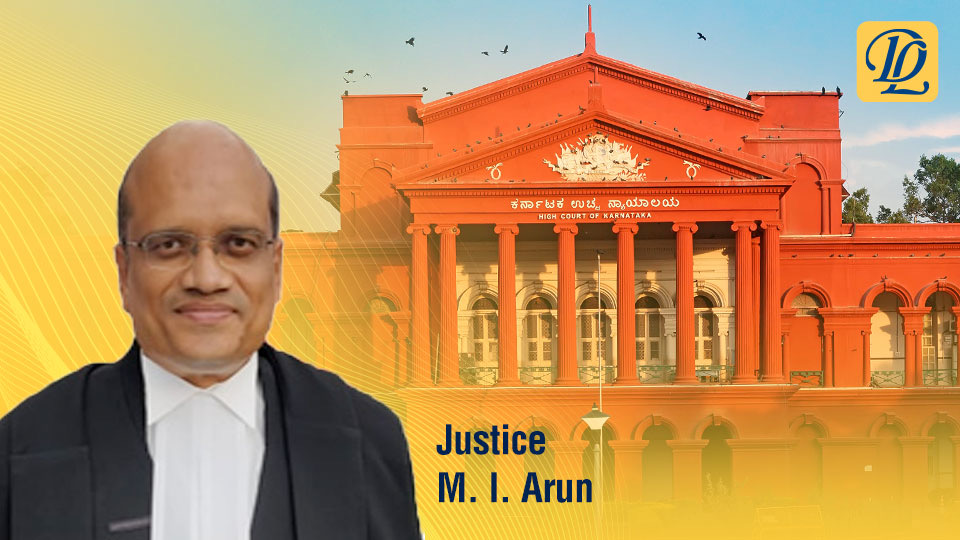
Justice M I Arun celebrates his 53rd birthday today.
Justice M.I. Arun was born on 24.04.1970 at Mysore. His father Shri. M. J. Indrakumar served as Registrar, Karnataka Lokayukta till his retirement in the year 1999.
Justice M.I.Arun did his early education in Dharwad, Arasikere, Bhardravathi, Bangalore and Mysroe. He studied SSLC from MES High School, Jayanagar, Bengaluru; PUC from Mari Mallappa Junior College, Mysore; Graduated from the National Law School of India University, Bengaluru in the year 1993.
Justice M.I. Arun enrolled as an Advocate on 09.06.1993; practiced under Shri A.N. Jayaram, Former Advocate General of Karnataka and Shri B.N. Dayanand. He started independent practice as an Advocate from the year 1996 and represented several Universities and various State Government Undertakings. He was a Central Government Senior Panel Counsel and also Additional Government Advocate for a brief period.
Justice M.I. Arun was elevated as an Additional Judge in High Court of Karnataka, Bengaluru on 07.01.2020 and assumed charge as a Permanent Judge on 25.09.2021.
Some of the important judgments delivered by Justice M.I. Arun
1. Industrial Disputes Act, 1947. Pendency of disciplinary proceedings cannot be a ground to deny the status of a protected workman unless the workman is also involved in criminal cases. https://dakshalegal.com/judgements/actionView/UwrlgHg4qePUUhxDQJYPzIlDR
2. Confiscation of goods under Section 130 of the CGST Act must be preceded by an opportunity of being heard and not mere opportunity of filing objections to the action contemplated. https://dakshalegal.com/judgements/actionView/SU2MQ5DjlSWfnLGkqH1LBb36g
3. Suit cannot be dismissed simply because Specified Value as contemplated under the Commercial Courts Act is not mentioned in the plaint. Court can order valuation and return the plaint if the valuation is more than Rs. three lakhs. https://dakshalegal.com/judgements/actionView/oSCA1wLEvaz5Wv5tmTpKvSP7v
4. Wife cannot be held liable under the N.I Act for dishonour of the cheque issued by her husband though the loan transaction is joint. https://dakshalegal.com/judgements/actionView/NXZQdnu9usb20xbkfvcWDDBrP
5. National Calamity Contingent Duty is a surcharge which can be levied independently of the excise duty. NCCD can be levied even in the absence of levy of excise duty. https://dakshalegal.com/judgements/actionView/aeJfaSq1x3KpxzUwGyTCLfRnX
6. Existence of a competing co-operative society in the area is only a guiding factor and not a restriction to permit new co-operative society under the Karnataka Co-operative Societies Act. https://dakshalegal.com/judgements/actionView/Y43XaBvVfRiisuhcLhrmcKyBy
7. Administrator under Section 27A of the Societies Registration Act cannot be appointed on vague allegations of irregularities in conducting election. https://dakshalegal.com/judgements/actionView/9zaOmZw9ankAXXtA0x90LYmcE
8. Evidence of hostile witness — Entire evidence of a hostile witness cannot be rejected ipso facto — Unreliable testimony may be rejected, reliable testimony may be accepted — 2020 SCC OnLine Kar 3309 : ILR 2020 Kar 2586 : (2020) 210 AIC 638 : (2020) 5 Kant LJ 360 (DB) : (2020) 3 AIR Kant R 244 : (2020) 5 KCCR 588
9. Hindu Succession (Karnataka Amendment) Act, 1990 (Karnataka Act No. 23 of 1994 w.e.f. 30.07.1994) — Section 6-a — Equal rights to daughter in co-parccnarv property — Partition took place by virtue of two partition deeds dated 06.02.2003 — Sale took place on 22.11.2004 — By virtue of Section 6(5) of the Hindu Succession (Amendment) Act, 2005, maintainability of suit filed by a daughter seeking rights in the co-parcenary property. Discussed. 2020 SCC OnLine Kar 3385 : ILR 2021 Kar 613
Held: (a) In the instant case, the partitions took place by virtue of two partition deeds dated 06.02.2003. The sale took place on 22.11.2004. If respondent No. 1 had no right over the properties in question by virtue of Karnataka Amendment which came into effect on 30.07.1994, then, on the ground that partition and sale took place prior to 09.09.2005, she would not get any right over the properties. But, if she had a right over the properties due to Karnataka Amendment which introduced Section 6-A to Hindu Succession Act, which was in force till it was eclipsed by the Central Amendment, in that event, she can maintain a suit for partition.
(b) The decisions of the Hon’ble Supreme Court referred to by the petitioners considered those transactions in which the daughters had no right over the property prior to the amendment made by the Parliament came into force. By virtue of the said decisions, the daughters cannot prefer a suit for partition, in the event if they had no right over the property prior to the amendment coming into force and the property was alienated prior to amendment coming into force. The above decisions of the Hon’ble Supreme Court do not bar the daughters from instituting a suit for partition, if as per prevailing law, prior to amendment she had a right over the property.
10. Industrial Disputes Act, 1947 — Earned leave — Earned leave is not a consequential benefit — If a workman does not work, he is not entitled to Earned Leave — Earned leave is not a consequential benefit and workman has to render active service and thereby earn privilege leave to his credit — Earned leave cannot have been earned as a matter of right, but by actual working Earned leave unless the relevant regulations expressly specifies otherwise cannot be considered as part of consequential benefits.–Earned leave is a privilege, a workman would be entitled to only by actual working and it cannot be earned as a matter of right even if he did not work. Even if he were to be in employment, he becomes entitled to it only if he works and earns it, otherwise not. It is similar to night shift or traveling allowance which accrue only if the person decides to work. If he does not work, in that event, he is not entitled to it. VIjaya Bank v. H.C. Jayaprakash, 2020 SCC OnLine Kar 642 : ILR 2020 Kar 1783 : (2020) 2 KCCR 1087 : 2020 LLR 414 : (2020) 2 CLR 135 : (2020) 3 Kant LJ 636 : (2020) 3 AIR Kant R 743
 Daksha Legal