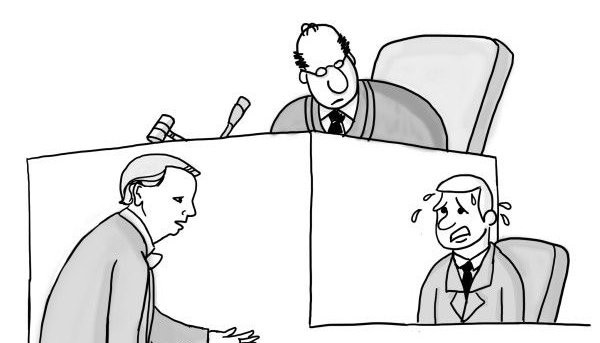
When one says I need to prepare for trial, it is always assumed that the person is preparing for cross-examination. I always thought that trial advocacy means only cross-examination. If you look at books on advocacy, you will find one small section on opening or closing arguments, on small section on examination in chief and the rest of the book will be on cross-examination. We recognize trial lawyers on the basis of their reputation in cross-examination. But is trial only about cross-examination?
A cross-examination is about only two things: Admissions or Contradictions. You either make the witness admit your case to the extent possible or contradict the opponent’s case. What is key here is to notice as to what is ‘the case’. There is no cross-examination without ‘the case’. So, what’s the case? Whatever the client says?
A client comes with a problem. A lawyer probes and asks the facts leading to the problem. Using that information, the lawyer has to frame the case. The lawyer decides what legal provisions would apply. For example, if a client complains saying that I had entered into an Agreement to buy property but the other side is refusing to sell now, then lawyer looks at the legal provisions viz. Transfer of Property Act or Indian Contract Act etc. He may ask for more information to examine potential defences and then frames the case. In software development context, this is like a client giving his requirements and the developer identifying and pitching a potential solution to the client.
In Principles of Judicial Evidence, James Fitzjames Stephen, the author of the Indian Evidence Act, 1872, explains beautifully that all rights and liabilities are dependant upon facts of the case. Judicial proceedings are initiated for ascertainment / adjudication of these rights and liabilities. In order to effectively do so, the law must make provision for two things: the substantive law that deals with the legal effects of rights and liabilities. Second being the procedure that must be used to apply the substantive law to particular cases.
He further elaborates that procedure will include two main branches: “First being the law of pleading which determines what in a particular case are the questions in dispute between the parties and second being the law of evidence which determines how the parties are to convince the court of the existence of that state of facts which according to the provisions of substantive law would establish the existence of right or liability which they allege to exist.”
Continue with the same example of the Agreement to Sell, the lawyer will frame the case on the contractual clauses of the Agreement to Sell and the provisions of the Indian Contract Act, 1872 and the Transfer of Property Act, 1882. This is the substantive aspect. The procedural aspect is about pleading your case – you will need to state all facts that are necessary to put the other side on notice about your case, what evidence can your produce to prove your case. After one pleads and leads evidence, comes the stage of cross-examination.
A trial involves two aspects: substantive and the procedural. The substantive aspect is about the intertwining of facts and the legal issues in a story. The procedural is about how to prove the story within the confines of the Evidence Act and the Civil Procedure Code. Cross-examination is a small portion of the procedural aspect of a trial. Cross-examination is essentially a tool to disprove whereas a trial is an exercise in proving which includes possible disproving of the opponent’s case.
A colleague once said, “the day I will know I am a complete lawyer is when I am able to predict the result of a trial at the time of drafting a legal notice or a reply notice.” This statement has made a deep impression on me. Legal notice is where one frames the case or the defence. There are umpteen examples of the case of the Plaintiff or the Defendant changing from the stage of notice till pleadings and thereafter at the stage of evidence. The contradictions would make the case unbelievable and consequently unprovable. Therefore, it is akin to pleading although it is a precursor to pleading.
There are also situations wherein in the reply notice or in the legal notice, a particular argument is put forth. On the basis of the reply or on a further study of documents, the argument is dropped. Sometimes, it proves to be an admission or contradiction or an omission which is beneficial to the opponent.
When we issue a notice or a reply notice, a trial lawyer takes into consideration the substantive aspects viz. the facts of the case and the documents. We read the reconcile the facts, fit into the legal requirements and frame the suit or the defence to a potential suit. This is called developing ‘the case’. We start nurturing this basic frame. We strengthen it with more documents, more information which helps us. Information which is against us is either ignored or explained. Attack points and weak points are noted and stored away.
Then comes the next stage of pleading. Pleading is about placing the basic facts necessary to point out the dispute between the parties, the substantive right to sue and the relief sought (in terms of the procedural law). Depending on how we frame the relief, we can either attract or avoid bars to relief such as jurisdiction, limitation, court fee or any other bar in law. If these objections are successfully raised, there would be no necessity of evidence at all.
There are enough judgments on evidence without pleading cannot be considered. Even if we were to elicit good answers, if it is not our pleaded case, the Court may disregard those admissions / contradictions as immaterial to the pleaded case. There is a requirement to anticipate the defence of the other side and cover it in the pleading. Therefore, our pleading becomes critical and it must be done after examination of all available evidence.
Documentary evidence and its probative value also prove useful without aid of cross-examination. Section 91 of the Evidence Act makes it clear that no oral evidence can be led as to terms of contract, grant or other disposition of property. If a document speaks as to certain facts, cross-examination on the contents of the document is pointless. In the digital world, communication is recorded contemporaneously by email, mobile or other means. Oral evidence is on very limited aspects. This also reduces the scope of cross-examination.
You do not even need to cross-examine and still win your case. To illustrate, there was an ex-employee who claimed damages from his former company for unlawful termination. The case of the Company was that he was required to sign a non-compete clause and an invention assignment agreement for the employment agreement to become operative. The case of the employee was that the offer letter was the only contract which contained the commercial terms which included 6 months severance for unlawful termination and that the offer letter did not refer to signing of these two documents. The ex-employee while producing the documents produced the photo copy of the non-complete agreement and the invention assignment agreement. This was objected to on the ground that there is no basis to assume the authenticity of the photocopies as they neither contained signatures of either party or was on the letterhead of the company. The witness unwittingly replied saying that these photocopies were enclosed along with the offer letter. After recording that statement, the documents were marked as part of examination in chief. Cross-examination on that aspect was proved unnecessary. On the strength of that statement, the Trial Court held that non-compete agreement and invention assignment agreement formed part of a composite contract and dismissed the suit.
Pleadings, examination in chief and evidence (oral and documentary) is the actual development of the software. Cross-examination is akin to testing of software for bugs. Sometimes you may never find a bug in your opponent’s case but the software itself may have weak structural foundation (pleadings or evidence). The modern trial lawyer’s focus must not be on cross-examination but have a holistic picture of the case. Even if you are an average cross-examiner, you can win more trials than the most seasoned cross-examiner if you are prepared on other aspects. Remember, trial is not about the cross-examination alone.
(Ajay J Nandalike is an advocate practicing in Bengaluru and New Delhi. Views are personal.)
 Daksha Legal