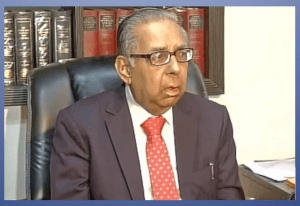
B.V.Acharya, Senior Advocate and former Advocate General for Karnataka.
In view of the continued and large scale misuse of the law of sedition (section 124A of IPC),of late there has been public debate and discussion on this topic. While many persons have been pleading for repeal of the said provision, few have been advocating for its retention on the ground that its repeal will encourage anti-national elements to incite hatred and contempt against the Government established by law leading to violence and law and order problem.
It is useful to refer to the origin of the enactment of this law in India. It is in the year 1870 that this provisions (Section 124A) was inserted in the Indian Penal Code by Act 27 of 1870. It is significant to note that this provision was inserted by the British Government sometime after the Sepoy Mutiny which is considered by some as first war of independence, the whole object of the provision was to terrorise people who were revolting against the British Government and were demanding freedom. The provision was thus aimed at helping the British Government to continue colonial rule in the country without any rebellion or protest by the local people. This provision is thus a colonial legacy.
The gist of the offence is any act which results in bringing hatred, contempt or dissatisfaction towards the Government established by law in India. It is specified that dissatisfaction includes disloyalty and feelings of enemity. Without doubt, the whole object was to make it punishable offence for Indian people who show disloyalty to the British Government or exhibit hatred or contempt towards it. Though by way of explanation it is clarified that any disapprobation of Government measures by lawful means is not an offence, the same had little effect of diluting the culpability expressed in the main section. The object of the provision is amply demonstrated by the fact that many leaders of the freedom movement including the Father of the Nation were tried and punished under this provision resulting in their long term imprisonment.
The object of this provision did not survive, once India got its independence and the colonial rule of the British came to an end. However, the provision still continues to be on the statute book even today, and the ruling parties have been misusing this provision to threaten and silence criticism of the Government by opposition parties. No party which came to power thought of repealing the same as it served the interest of the Government of the day.
Now a writ petition has been filed before the Supreme court challenging the validity of the provision on the ground that it violates fundamental right of freedom of speech and expression.
On an earlier occasion in the year 1962 the constitutional validity of the said provision was challenged before the Supreme Court on similar grounds. A Constitution Bench of the Supreme Court upheld the constitutional validity interpreting the provision in the context of explanation to the said section and holding that it is only when the action has tendency to create public disorder or disturbance of law, that the section gets attracted and that any criticism of the Government, however strongly worded without inciting violence does not amount to an offence. The same view has been reiterated in subsequent rulings. Notwithstanding the same, law enforcing agencies ignoring them have been misusing the provision to please political masters.
The Bench of the Supreme Court presided over by the Hon’ble Chief Justice has now advised the Union government to revisit the law. In my opinion, in a democratic country like India where freedom of speech and expression finds a predominant position such as Section 124A of the Indian Penal Code can have no place. In a democracy, there is bound to be criticism of the government which may lead to hatred, contempt or dissatisfaction towards it. The same cannot be an offence and misuse of this provision to silence this criticism is highly objectionable. To take care of acts of violence and law and order problem, there are other laws in the statute book. Hence no case for retention of this provision is tenable
I hope the Government of India will take note of the overwhelming public opinion as also prima facie opinion of the Supreme Court and take immediate steps to repeal this very much misused provision.
 Daksha Legal