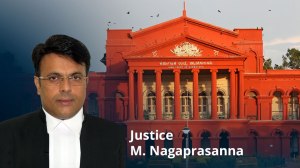
Dr. Raghavendra H.K. vs The State of Karnataka and others. Writ Petition 4923/2020 decided on 16 January 2021.
Judgment Link: http://judgmenthck.kar.nic.in/judgmentsdsp/bitstream/123456789/360403/1/WP4923-20-16-01-2021.pdf
Relevant paragraphs: 17. Insofar as the contention of the respondents that the petitioner is estopped from challenging the selection process after having participated on the ground of acquiescence is concerned, the said principle is not a panacea to all the ills and illegalities committed by the Selecting Authorities. It is noticed that the Selecting Authorities time and again commit glaring illegalities in selections contrary to the statute, appoint candidates contrary to law and try to take shelter under the plea of estoppel against the candidates who challenge the act of the Selecting Authorities and consequent appointments, on a specious plea that the candidate cannot turn around and challenge the selection process or procedure stipulated for selection, after having participated in the selection process. The same plea is advanced in unison by the respondent – University and the selected candidate. The plea of the said respondents is unacceptable to me.
18. The University has made selections blatantly contrary to Rule 6 of the Special Rules which has resulted in the appointment of respondent No.7 to the post of Assistant Professor in the Department of English and denial of the entitlement of the petitioner to be considered for such appointment. The petitioner has not questioned the notification, process of selection or procedure adopted, but has questioned the selection of respondent No.7 as contrary to law. Such a challenge can be made only after the outcome of the selection process for which the candidate should partake in the said selection process. This view of mine, in this regard, is fortified by judgments of the Apex Court in the case of Raj Kumar vs shakri raj reported in (1997) 9 SCC 527.….But in his case, the Government have committed glaring illegalities in the procedure to get the candidates for examination under the 1955 Rules, so also in the method of selection and exercise of the power in taking out from the purview of the Board and also conduct of the selection in accordance with the Rules. Therefore, the principle of estoppel by conduct or acquiescence has no application to the facts in this case.
19. The Apex Court in the latest judgment, in the case of Dr.(Major) Meeta Sahai Vs. Union of India reported in (2019) 20 SCC 17, considering the entire case law in point has held as follows:,,,,,,However, we must differentiate from this principle insofar as the candidate by agreeing to participate in the selection process only accepts the prescribed procedure and not the illegality in it. In a situation where a candidate alleges misconstruction of statutory rules and discriminating consequences arising therefrom, the same cannot be condoned merely because a candidate has partaken in it. The constitutional scheme is sacrosanct and its violation in any manner is impermissible. In fact, a candidate may not have locus to assail the incurable illegality or derogation of the provisions of the Constitution, unless he/she participates in the selection process.
If the facts obtaining in the case at hand is considered in the light of law laid down by the Apex Court in the afore-extracted judgment, the petition cannot be shown the doors of the Court for an exit, merely because the petitioner has participated in the selection process as it is only the outcome of selection that has brought out the illegality committed by the University in selecting respondent No.7 contrary to the Special Rules.
21. Thus, in terms of the afore-extracted judgment of the Apex Court considering all the judgments on the issue of estoppel, acquiescence and waiver as in the case of Dr.(Major) Meeta Sahai (supra) held that illegality in a selection process can be found by a candidate only on its participation and not otherwise.
Writ Petition allowed.
Compiled by S. Basavaraj, Advocate, Daksha Legal.
 Daksha Legal