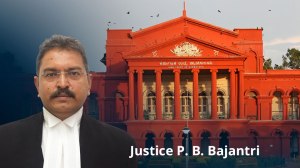
Bangalore Turf Club Limited vs State Information Commissioner. Writ Petition 18449/2015 and connected matters decided on 13 January 2021.
Judgment Link: https://karnatakajudiciary.kar.nic.in/noticeBoard/WP18449.2015_16012021.pdf
Relevant paragraphs: 2. In these petitions, contesting respondents –
complainants filed applications seeking certain information from
the respective petitioners. In not providing information sought
or in not taking any action on their application, contesting
respondents resorted to approach KIC and KIC passed order
against each of the petitioner.
30. …it is evident that petitioners have availed concession of lease
amount. If one takes note of the market value as on the
date of various lease deeds, it is evident that larger
chunk of monetary gains has favoured the petitioners
from the State Largesse. In fact, State Government
should have resorted to distribute the State Largesse
while adhering to Article 14 of the Constitution, Courts
have time and again held that State Largesse is required
to be distributed while adhering to Article 14 of the
Constitution
31..one has to come to the conclusion that
State Largesse had not been distributed in the manner
known to law. At the same time, each of the petitioners are
beneficiaries of State Largesse at a concessional rate as is evident from the records and findings given by the KIC in its
orders read with audit reports.
32. It is necessary to take note of what is meant by
‘Largesse’ – Government is simply funding its Largesses
towards private charities anyway, and politicizing the nonprofit world to an unprecedented degree in the process.
33. Further, the following would come under the
definition of ‘Largesse’ viz., synonyms of ‘Largessee’ are
bestowal, comp, donation, durative, faining, free bie, gift,
give away, handsel, lagniappe, present, presentation, alms,
benefaction, beneficence, benevolence, charity,
contribution, dole, hand out, oblation, offering,
philanthropy, tithe, grant, subsidy, remberance, tribute,
valentine, bonus, boon, windfall, courtesy, favour,
generosity, sacrifice, gratuity, propine, award, prize,
reward, liberalise. If these meanings are taken into
consideration for the purpose of State Largesse, one has to
draw inference that each of the petitioners are the beneficiary of substantially financed by way of indirectly
by funds provided by the Government.
36. No-doubt each of the petitioners were not
controlled by the Government of Karnataka in any manner
and at the same time Section 2(h) of Act, 2005 are to be
read independently from Section 2(h)(a) to (d)and (i) and
(ii). If part of (d) and (i) and (ii) ingredients are taken into
consideration, petitioners would fall under the definition of
‘public authority’, since, monetarily each of the petitioners
were beneficiary as their lease deeds revealed that they have been given substantial financial aid/concession.
47. In view of the principle laid down in the case of
THALAPPALAM’s supra and DAV supra, it is crystal clear
that Section 2(h) is required to be taken note of “and
includes any” (i) and (ii) are to be read independently.
Petitioners are all non-government organizations and who are all benefited from the State like indirectly funded by the
State Government, while availing at concessional rate in
respect of leased out land in favour of each of the
petitioner. Consequently, non-government organization
whoever benefited by directly or indirectly by funds
provided by the appropriate Government would fall under
‘‘public authority’’ under Section 2(h) of Act, 2005. Since
substantial financing can be both direct or indirect. To give
an example, if a land in a city is given free of cost or on
heavy discount to hospitals, educational institutions or such
other body like sports club, this in itself could be substantial
financing. The very establishment of such an institution, if
it is dependent on the largesse of the State in getting the
land at a cheap price, would mean that it is substantially
financed. Further, the value of the land will have to be
evaluated not only on the date of allotment but even on the
date when the question arises as to whether the said body
or NGO is substantially financed. In Writ Petition
No.58192/2013 the order of KIC dated 16.09.2013 at
para.10 reveals the following details of extent of land, building leased and the period of lease, lease rent to be
released, amount of lease rent released and revenue
foregone:
50. If these material information is taken into
consideration, one has to draw inference that petitioners
do fall under the definition of ‘public authority’ under Act.
Petitions dismissed.
Compiled by S. Basavaraj, Advocate, Daksha Legal.
 Daksha Legal