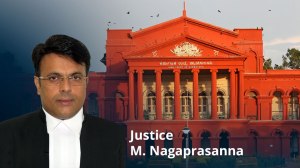
M.B. Siddalingaswamy vs The State of Karnataka and others. Writ Petition 63405/2016 decided on 23 November 2020.
Judgment Link: http://judgmenthck.kar.nic.in/judgmentsdsp/bitstream/123456789/354030/1/WP63405-16-23-11-2020.pdf
Relevant paragraphs. 5. ….By the impugned order dated 11-11-2016 the Commission directed the State Government to accord retrospective seniority to the fifth respondent with effect from 17-09-2012 and also grant him all consequential monetary benefits and also effect correction of date of entry into service of Superintendent in the seniority list inter se between the petitioner and the fifth respondent.
9. “whether the Commission was well within its jurisdiction to give a positive direction to the State Government upon adjudication of rights of the parties?”
10…it is germane to notice the genesis of the Commission. With the objective of replacing the Special Officer created under Article 338 when the Constitution was adopted, with a high level Five Member Commission for more effective management of constitutional safeguards for scheduled castes and scheduled tribes the Constitution (65th amendment) Act, 1990 was enacted.
Provisions of Article 338 of the Constitution of India and Karnataka Scheduled Castes and Scheduled Tribes Act, 2002 noticed.
13..A reading of the afore-extracted Sections 8 and 10 of the said Act, makes it abundantly clear that the Commission is not empowered to adjudicate upon the rights of parties. The power vested with the Commission of Inquiry and submission of a report cannot be extended to adjudicate all disputes between individual and a State or a statutory authority. The powers conferred do not contemplate that the Commission can examine matters like a civil Court and adjudicate dispute and pronounce its decision either interim or final or issue a direction of the kind that is issued in the case on hand.
14 & 17 The Commission cannot be construed to be a Tribunal or a forum discharging the functions of a judicial character or Court. Article 338 of the Constitution itself does not entrust the Commission with the power to take up the role of a Court or an adjudicatory Tribunal and determine the rights of parties inter se.. …Commission is not empowered to adjudicate and decide disputes between the parties and pronounce its orders either interim or final.
Compiled by S. Basavaraj, Advocate, Daksha Legal.
 Daksha Legal