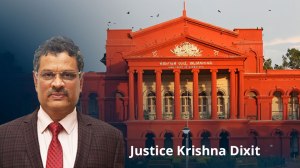
Dr. Jaya Balasundaram and others vs Sahasra Gastroenterology and Obesity Clinic Pvt Ltd. Writ Petition 14226/2020 decided on 8 December 2020.
Judgment Link: http://judgmenthck.kar.nic.in/judgmentsdsp/bitstream/123456789/352896/1/WP14226-20-08-12-2020.pdf
Relevant paragraphs: Facts: Whilst Execution Case is being processed, some initial steps having been taken for levying enforcement of the award in question, learned Judge has employed some arguably intemperate language in his orders reflecting on the professional conduct of learned counsel for the petitioners who is a senior member having a considerable standing at the Bar; therefore, petitioners are knocking at the doors of the writ court seeking expunction of the said “adverse observations”.
5. Reproducing the text of the said three orders may not be advisable. Suffice it to say that, judges should not be too sensitive in the conduct of court proceedings or to the comments of the onlookers; in any circumstance, they are not expected to ink their orders with a pen dipped in acid either; cause of judicial process is served more by restraint of unpleasant expressions than otherwise; if the court orders are constructed with avoidably pungent words, the stream of justice runs the risk of being tainted as ‘impure’.
“In its widest sense, advocacy is the art of convincing others, that is to say, the art of persuasion … In its legal context, advocacy is the art of conducting cases in court, both by argument and by the manner of bringing out the evidence, so as to convince the court or jury …For members of the bar, who make a practice of appearing in court, advocacy is of first importance and ranks at any rate on an equal level with a knowledge of the law…” writes John Munkman in “The Technique of Advocacy”, LexixNexis Butterworks, London, 1991 Edn.; at times persons associated with adjudicatory process exhibit more emotion than what is normal, for inscrutable reasons; perhaps ‘chimp’ hidden in humans needs no instigation to act and therefore has to be handled tactfully; prudence warrants that all stakeholders in adjudication relegate their emotions to the backseat so that the purity of judicial process is maintained; more is not necessary to elaborate.
7. It hardly needs to be reiterated that the Bar and the Bench being two inseparable wheels of the same chariot, have to move shoulder by shoulder, each being complementary and supportive to the other, the ‘bar’ in between, notwithstanding; even if the submissions of the counsel are, at times, not couched in a pleasant language, a judge is expected not to loose his cool in his expression, be it oral or in writing; efficacy of the orders can be maintained sans acidity in the language employed.
8. The language used in the subject orders though accords with the common usage, falls a little short of the high standards fixed by the judicial traditions; the tenor of the said orders appears to cast aspersion on the professional conduct of the counsel and therefore needs to be toned down, consistent with the majesty of the Institution of Judiciary. In view of the above, although impugned orders are sustained in terms of their effect & efficacy, there being no challenge thereto, the text by which they are structured shall be read down and the observations therein casting aspersion on the professional conduct of the counsel for the petitioners, shall be treated as having been expunged from the record. It hardly needs to be stated that nothing in this judgment shall be construed as suggesting even remotely anything adverse against the learned Judge of the court below or the counsel for the petitioners.
Compiled by S. Basavaraj, Daksha Legal.
 Daksha Legal