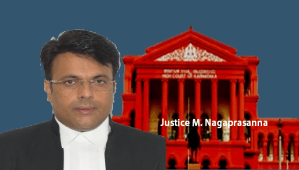
Bhuvaneshwari V Puranik vs The State of Karnataka and others. Writ Petition 17788/2018 decided on 15 December 2020.
Judgment Link: http://judgmenthck.kar.nic.in/judgmentsdsp/bitstream/123456789/352927/1/WP17788-18-15-12-2020.pdf
Relevant paragraphs: “Half the world; and not even half the chance” is the cry of the petitioner in this petition on being denied consideration for appointment on compassionate ground on the death of her father on the score that she is “a married daughter”.
9. “Whether Rule 2(1)(a)(i), Rule 2(1)(b) and Rule 3(2)(i)(c) of the Karnataka Civil Services (Appointment on Compassionate Grounds) Rules, 1996 are ultravires the Constitution for it offends Article 14 of the Constitution of India?”
10. It is by now a well settled principle that object of compassionate appointment is to help the family tied over the crisis that befalls them on the death of the sole breadwinner of the family. It is given, in a given circumstance, so that the family will not be put to jeopardy by being driven to impecuniosities and condemned by penury. It is for this reason the emphasis on appointment on compassionate grounds is immediacy of appointment. This is the principle that is laid down in plethora of judgments of the Apex Court interpreting the need, benefit and its limitations.
12.1 & 12.2 Article 14 of the Constitution of India prohibits the State from denying any person equality before the law or equal protection of the laws. Article 16 is of application of general Rule of equality as laid down in Article 14 with special reference to opportunity for appointment and employment under the State. Article 15(1) prohibits discrimination on the ground of religion, race, caste, sex or place of birth. It is an extension of Article 14, which expresses application of principle of equality. Therefore, no citizen shall be discriminated on the grounds of race, caste, sex or place of birth religion. Article 16 takes its root from Article 14 and ensures equality of opportunity in matters of employment under the State. Therefore, the fundamental right to equality means that persons in like situations under like circumstances should be treated alike. Article 14 of the Constitution of India ensures equality among equals and its main object is to protect persons similarly placed against discriminatory treatment. The equality before law guaranteed under Articles 14, 15 and 16 is a constitutional admonition against both the legislative and executive organs of the State, neither the legislature nor the Rule making authority can make a law or a Rule which is violative of these articles.
12.3 The case of the petitioner and the issue raising a challenge to the constitutional validity of the provision relating to appointment on compassionate grounds will have to be tested on the bedrock of the purport of the aforesaid articles.
14.5 It is trite that Constitution and its interpretation grows according to the living needs of the citizens. It is dynamic and not static. The interpretation of law has always undergone a change with changing times. If the offending provision is left as it is, it would be putting the clock back from where the law has progressed over the years.
14.6 The case at hand is a classic example of law being anachronistic as in terms of the Rules, petitioner applies for compassionate appointment when the son declines the same on the ground that he is not interested. The Rule gives such a liberty to the son to even deny the benefit on the ground that he is not interested. The son of the deceased employee in the case at hand declines to accept appointment on the ground that he is not interested. The daughter is denied on the score that she is married. Therefore, the Rule which declines such a benefit to a daughter merely on the ground that she is married is per se discriminatory.
HELD: Exclusion of married daughters from the ambit of expression ‘family’ in Rule 2(1)(a)(i), Rule 2(1)(b) and Rule 3(2)(i)(c) of the Karnataka Civil Services (Appointment on Compassionate Grounds) Rules, 1996 is illegal and unconstitutional being violative of Articles 14 and 15 of the Constitution. Word “unmarried” in Rule 2(1)(a)(i), Rule 2(1)(b) and Rule 3(2)(i)(c) of the Karnataka Civil Services (Appointment on Compassionate Grounds) Rules, 1996 is struck down.
Compiled by S. Basavaraj, Daksha Legal.
 Daksha Legal