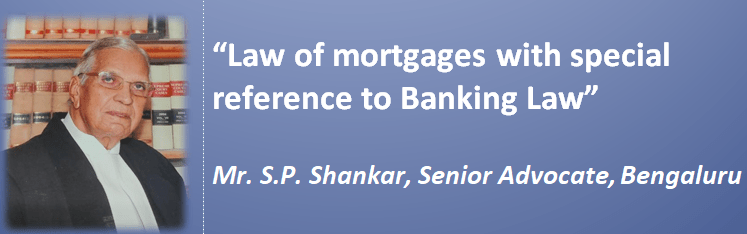
Mr. S.P. Shankar, Senior Advocate, Bangalore
PDF File
Law of mortgages with special reference to Banking Law
Banking institutions, in India, are primarily supporting every commercial
transaction in aid of development of commercial enterprise. Howsoever well
possessed a man is, he would not convert his assets into liquid cash, for
purposes of investment in trade/commerce. He necessarily starts such
enterprises with borrowed funds. It is in this manner banking institution would
picture itself in trade and commerce. A banker is obviously a stranger to an
entrepreneur. Words of entrepreneur are taken as true and correct and on that
basis the banker would take up the proposal of the entrepreneur for processing
loan and the like. Risk–appetite is common to the banker and the
entrepreneur. The banker who deals with public money has greater
responsibility in marshalling its funds, channelizing the same for various
purposes and closely supervise utilization/application of funds by the borrower
and lastly, ensure recovery with interest and costs. The whole process is
complicated. Bankers have neither experience nor enterprise muchless
expertese in running the industry itself, should the repayment of borrowed
money is delayed or staggered. Entrepreneurs have often ended penniless,
midstream in their business. This aspect would destroy the confidence in the
entrepreneur and hopes of the banker besides affecting the security of the
depositors.
It is in the above background, collaterals and security for repayment of loan
with interest assumes primary importance. As stated earlier, bank deals with
funds of the depositor. Bank only manages such funds prudently and
economically so that besides serving the depositors, the bank should make
reasonable profit to take care of its administrative expenses and also provide
for accumulation of funds. Technical terms are avoided.
To strike a balance in the banking business, collaterals and securities for loan
would assume greater role. Even in the matter of obtaining security, bank has
to be prudent both in terms of getting the best security and loan processing is
less expensive. It is in this background, Law of Mortgages would picture itself
in the scenario. Mortgages of immovable properties and charges on them are
found and dealt with in chapter IV of Transfer of Property Act vide Sections
58-104. Kinds of Mortgages are dealt with in Section 58. They are simple
mortgage, Mortgage by conditional sale, Usufructuary mortgage, English
mortgage, Mortgage by deposit of title deeds and Anomalous mortgage. Of
several mortgages the one that facilitates the banker is the Mortgage by deposit
of title deeds.
Mortgage by deposit of title is also known as equitable mortgage. Subject
matter of Equitable mortgage is the “interest” of the mortgagor in the
mortgaged property, in contra distinction to “Right, Title and Interest” in the
property itself. The striking illustration in this behalf is the interest of lessee in
the mortgaged property, which could be merely the leasehold rights. This
aspect is further supported by Law vide Section 108(j) of T.P. Act. Section 108(j)
would empower and authorize lessees to transfer absolutely or by way of
mortgage or sub-lease the whole or any part of his “interest” in the demised
property. Section 58(d) R/w Section 108 (j) would thus permit a situation
where a long term lessee may mortgage the lease hold rights and secure loan
from a bank. This comes by way of assignment of lease hold rights. The earliest
decision in this behalf is one rendered by five judges of the Hon’ble Supreme
Court in the case reported in AIR 1952 SC 156. This decision is followed every
now and then, to sustain the banking transaction of loan advanced by a
banker on the security of lease hold rights.
Equitable mortgage is and shall not be a document containing terms of loan
like the amount lent, rate of interest or other terms and conditions of loan. An
equitable mortgage merely consists of a report or a writing by the borrower
affirming that he has deposited the title deeds, with the intent of securing loan
and creating a charge on his interest in the property and more importantly
recording the fact that he has delivered possession of deeds of title. The
significant and beneficial aspect of equitable mortgage is that property situated
anywhere in India can be subject matter of equitable mortgage at place other
than where the property is situate and in the authorized cities vide Section
58(d). Only a few cities in India are designated cities, where title deeds are
deposited. By fiction, equitable mortgage can be created by deposit of title
deeds of property situated elsewhere, in a designated city. This facility afforded
by the statute would augur well, in the matter of banking transactions. It does
not involve stamp duty as it is a mere report or memorandum evidencing
deposit of title deeds and delivery of those documents. It does not require
registration. The question as to whether equitable mortgage by deposit of title
deeds requires registration or not has been resolved by Apex Court in AIR 1950
SC 272, AIR 1965 SC 1591 and many more. High court of Karnataka in ILR
2000 Kar 1962 has held that memorandum accompanying the deposit of title
deeds containing only a statement that a deposit is made by way of security for
repayment of loan, does not need registration. The memorandum is only
evidence of the fact that the title deeds are deposited with the Mortgagee.
Documents of title could be mere patta of lands in mufassil areas. Document of
Mortgage is itself is a title of the mortgagee. An expired lease is a document of
title if it is renewed and kept valid. Share certificates could be document of
title. Where possession is given to vendee on the basis of agreement to sell,
such agreement is a good security. Original probate of a will accompanied by
certified copy of redemption relating to the property, even if lost, can create
equitable mortgage. The list of title deeds is only illustrative.
Essential aspect is delivery of title deeds made by the borrower to the creditor
or his agent. Such delivery must be with intent to create security. The bank
would save cost of stamp duty and registration and would therefore facilitate
credit transaction. This would improve commercial enterprise, a positive aspect
of Law.
Mortgage is a transfer of an interest in immovable property. The immovable
property has to be and is always specific. Mortgage could be to secure existing
or future debts. Mortgage can be effected by co-owners, Pardanashian woman
or by beneficiaries under Trust. There could be mortgage in favour of a minor.
In Simple mortgage, possession remains with mortgagor. A mortgagor would
bind himself personally to pay if the security offered in inadequate. Mortgagee
shall have the right to sell or cause the mortgaged property to be sold for
recovery of dues.
Mortgage by conditional sale creates liability. This type of mortgage is
ostensible sale with personal liability on default of payment of mortgage money
on a given date. There is distinction between mortgage by conditional sale and a
sale with clause for repurchase. That stipulation/clause for repurchase should
be in the same document contemporaneously entered while taking the loan.
Distinction between sale and mortgage would itself be a subject matter of
serious discussion.
Usfructuary mortgage involves delivery of possession, right of mortgagee to
appropriate rents and profits. There is no personal liability of the mortgagor.
Time limit for redemption is stipulated. Distinction between usfructuory
mortgage and lease is apparent and should be clearly understood.
An English mortgage is one where personal liability exists. Transfer is absolute
and not conditional, in contrast. There can be a proviso for re-conveyance.
Possession of the property is given to mortgagee.
Anomalous Mortgage is one that does not come under any of the above
mortgages.
Rights and remedies of mortgagee are set out in Chapter IV vide Sections 67,
67A, 68, 69, 69A -79. Marshalling and contribution are also provided in
respect of security to the bank. Thus mortgage by deposit of title deeds would
make the transaction ( borrowing from and lending by banks to debtors) an
effective and economical mode from the point of view of the Banker and the
borrower.
In addition, the bank has now the support of DRT Act and Securitization Act.
Jurisdiction of civil courts is barred in respect of recovery of dues outstanding
to a bank. Separate Forum is created in these days of Tribunalisation.
Realising the rigors of civil litigation, accompanied by need to pay advolerm
court fee and unimaginable contest raised by the borrowers and the never
ending process of execution, Union of India enacted DRT Act and Securitization
Act giving power to the banking institution to recover debts in an
expeditious manner and in the most inexpensive procedure. The laudable
object of Union of India in enacting this enactment is set out in Mardia
Chemicals.
Bank has the right to sell the mortgaged property. Though this right to sell is
available in common law it has its own inhibitions. Securitization Act has made
the maters far easy and has stipulated several conditions against the borrower,
were he to indulge in procrastinating means and methods. Sections 13 to 17 of
Securitization Act serve as a Code by itself. Banks are authorized to sell the
mortgaged property, realize the dues and make the recovered amount available
for further advances. This perspective is laudable from the point of view of law
makers. In reality even these two enactments have been deprived of the
intended teeth and verve.
Law of mortgages obtaining in common law, has yielded in favour of relieving
the bank from rigors of unending litigation and has assisted the borrower in
reducing the cost of litigation. This is hardly realized by the borrowers
muchless by the institution of Courts.
Validity of Securitization Act and the special procedure for bank for recovery of
dues have been tested, to the relief of Bankers. The common law remedies
available to a borrower including one time settlement is not be applied to or
enforced on the bankers. One time settlement ( OTS) is a matter of discretion.
Circular of RBI confers discretion on the Bank but never confers a right on
borrower. Inspite of this undeniable statement of Law borrowers invoke Article
226 and keep the banks under strangle hold.
Yet, the society has witnessed large scale borrowings and un-pardonable
defaults on the part of celebrated borrowers like Vijaya Malya, Nirav Modi,
Subrotho Mukherji and the hallowed persons. Society has also evidenced public
authorities like Ministers pressurizing the bank to lend money to these
celebrated and favoured borrowers. It became the lot of court in England to
notice and highlight in extradition proceedings that huge loans to Vijaya Malya
was blessed by the then Finance Minister and Prime Minister. The other
illustration is that of Punjab National Bank and allied banking institutions as
well as Co-operative banks. It is time to rationalize banking practices and
secure the interest of depositors irreversibly.
RBI is the prime and Central Bank of India. It is enjoined under the Banking
Regulation Act 1949 and RBI Act to assume responsibility, impose banking
sanctions and help recover huge debts. No debt is less than 10 to 15 thousand
crores. Interest is accruing. It is time that the Reserve Bank of India takes the
role of monitoring and enforce fiscal discipline.
S.P. Shankar
4-12-2020 Senior Advocate
 Daksha Legal