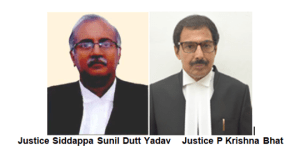
Mahadevi and others vs Shivaputra and another. Miscellaneous First Appeal 201689/2016 (MV) decided on 20 November 2020.
Judgment Link: http://judgmenthck.kar.nic.in/judgmentsdsp/bitstream/123456789/349819/1/MFA201689-16-20-11-2020.pdf
Relevant paragraphs: 11. …..the vehicle itself was seized on the helpful production of the same by respondent 1, who is none other than the younger brother of deceased on 10.07.2013, a good 103 days after the accident. This also, as rightly observed by the learned Tribunal, probabalises the circumstance that since this was a ‘hit and run’ case, the vehicle of a close relative was involved taking advantage of the fact that it was covered by insurance policy in order to secure compensation for the death of the deceased.
14. Further, we find that in the said judgment, there is no discussion of the relevant provisions of Code of Criminal Procedure or other cognate provisions of law under which the police authorities would investigate and file charge sheets and on the probative value of the charge sheets vis-a-vis the involvement of a motor vehicle in causing the accident before the Tribunals trying the compensation cases. Experience of the recent past shows that instances of fraudulent/collusive involvement of motor vehicles duly covered by insurance policy in accident cases are burgeoning and if the insurance companies are saddled with the burden of challenging the charge sheets filed throughout the country without there being no clear legal mandate to do so, their work would be seriously crippled and they would not be able to do their insurance business without enhancing the premium, thereby further burdening the ever suffering owners of motor vehicles. Even the most liberal reading the provisions of the Motor Vehicles Act, 1988 does not spell out such a requirement.
15. The question is one of fundamental importance – what is the standard of proof applicable in these proceedings? On whom is the initial burden of proving the accident or, as in this case, involvement of the offending motor vehicle cast? Is not still the standard of proof one of “preponderance of probabilities”? Is a mere charge sheet, which in this case is shown to be deficient in truth sufficient to tip the balance only on the premise that insurance company has not dipped deep into its pockets to challenge the charge sheet- what with the toxic nexus between the black sheep among the police, medical professionals and touts of every kind masquerading the field which has become a notorious fact of life.
APPEAL DISMISSED
Compiled by S. Basavaraj, Advocate, Daksha Legal.
 Daksha Legal