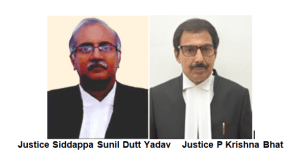
Dilip vs Nitin Jain. M.F.A. 200139/2018. Decided on 7 October 2020. Justice Siddappa Sunil Dutt Yadav and Justice P. Krishna Bhat. Judgment link: http://judgmenthck.kar.nic.in/judgmentsdsp/bitstream/123456789/343597/1/MFA200139-18-07-10-2020.pdf
Relevant Paragraphs. 4. The only contention urged on behalf of the appellant is that the learned Tribunal was in error in absolving the Insurer of the offending vehicle, only on the ground that the offending vehicle was having permit to ply only within the territorial jurisdiction of Humnabad Municipal area and at the time of the accident the offending vehicle had moved outside the said jurisdiction and accident had taken place in the district of Kalaburagi where it had no permit to ply. In support of the said contention, learned counsel for the appellant places reliance on the observations of the Hon’ble Supreme Court in the case of Amrit Paul Singh and Anr. Vs. Tata AIG General Insurance Company Limited & Ors. reported in (2018) 7 SCC 558.
5. Learned counsel for the Insurer of the offending vehicle Sri Manvendra Reddy vehemently contends that while he has no dispute about the proposition of law laid down in Amrit Paul Singh’s case, the learned Tribunal ought to have held that there was contributory negligence on the part of the truck which was parked by the side of the road without displaying signals as required under Sections l22 & l26 of the Motor Vehicles Act, l988.
7. It is necessary to refer to the observations of the Hon’ble Supreme Court in Amrit Paul’s case at para-24, which reads as under: “24. In the case at hand, it is clearly demonstrable ƒrom the materials brought on record that the vehicle at the time oƒ the accident did not have a permit. The appellants had taken the stand that the vehicle was not involved in the accident. That apart, they had not stated whether the vehicle had temporary permit or any other kind oƒ permit. The exceptions that have been carved out under Section 66 oƒ the Act, needless to emphasise, are to be pleaded and proved. The exceptions cannot be taken aid of in the course of an argument to seek absolution from liability. Use of a vehicle in a public place without a permit is a fundamental statutory infraction. We are disposed to think so in view of the series of exceptions carved out in Section 66. The said situations cannot be equated with absence of licence or a fake licence or a licence for different kind of vehicle, or, for that matter, violation of a condition of carrying more number of passengers. Therefore, the principles laid down in Swaran Singh and Lakhmi Chand in that regard would not be applicable to the case at hand. That apart, the insurer had taken the plea that the vehicle in question had no permit. It does not require the wisdom of the “Tripitaka”, that the existence of a permit of any nature is a matter of documentary evidence. Nothing has been brought on record by the insured to prove that he had a permit of the vehicle. In such a situation, the onus cannot be cast on the insurer. Therefore, the Tribunal as well as the High Court had directed that the insurer was required to pay the compensation amount to the claimants with interest with the stipulation that the insurer shall be entitled to recover the same from the owner and the driver. The said directions are in consonance with the principles stated in Swaran Singh and other cases pertaining to pay and recover principle.” As could be made out from the above, in the case before the Hon’ble Supreme Court, the offending vehicle had no permit at all. In the instant case, the offending vehicle did have a permit but in violation of the restricted zone of the permit, it was taken beyond its operative limits at the time of the accident. Thus, the principle of ‘pay and recover’ should apply with equal vigor in this case as well.
8. In view of the above, the finding of the learned Tribunal that respondent No.4 is not liable to pay the compensation is incorrect and the said finding is required to be modified with the observation that respondent No.4 shall first satisfy the award amount and thereafter it shall recover the same from the respondent No.3.
Compiled by S.Basavaraj, Daksha Legal
 Daksha Legal